Workflow engine · 2016–2017
A Composable Workflow Engine
A workflow execution engine I designed from scratch for highly customized approval systems.
Complex approval rules were modeled as a composable tree of nodes with explicit execution states.
01 / Context
What did I build?
I designed and implemented a lightweight workflow execution engine for an OA system with highly customized approval rules.
The reusable engine was independent of the approval forms and business modules that used it.
Read the diagram description
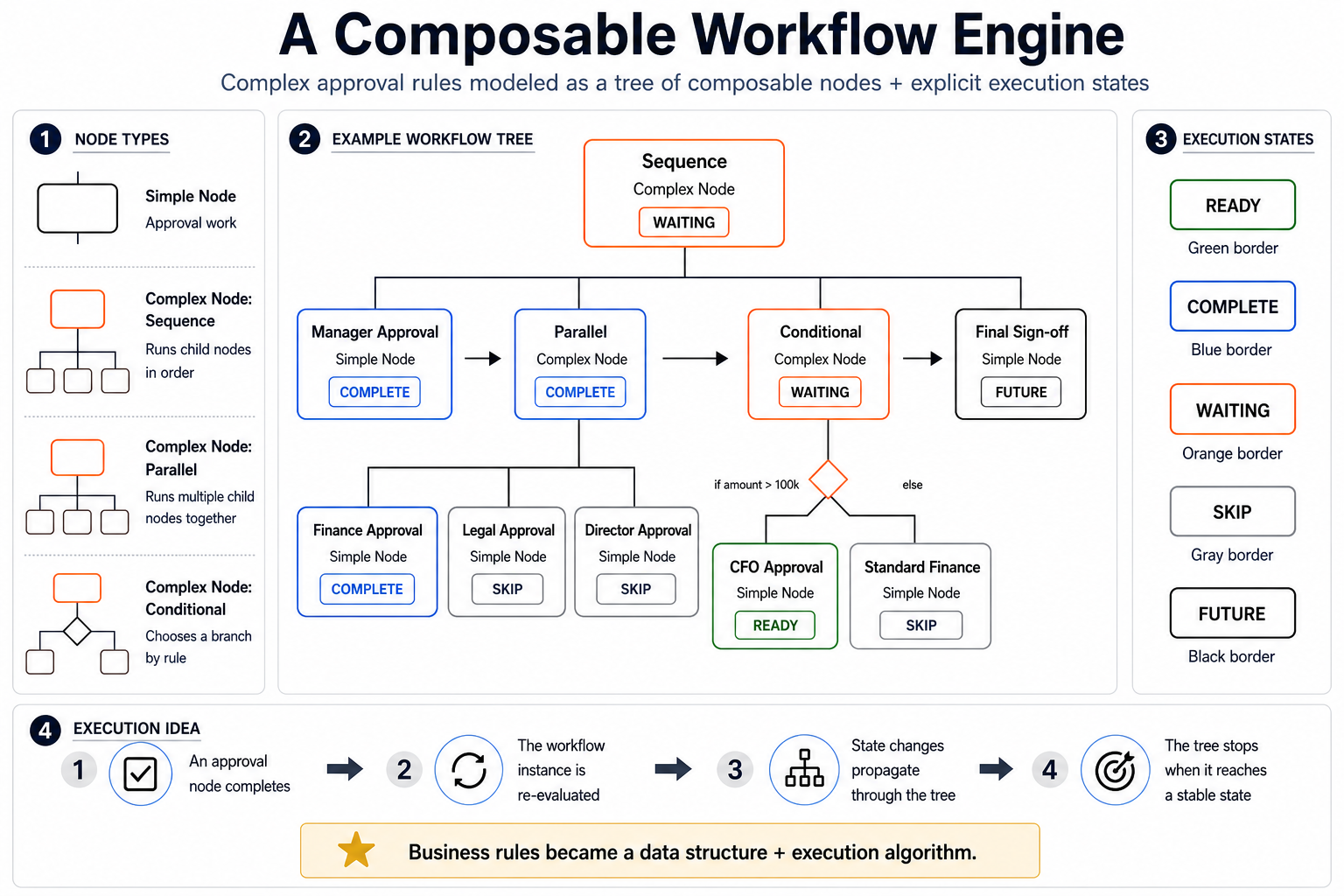
The diagram lists Simple Node, Sequence, Parallel, and Conditional as the four node types. READY uses a green border, COMPLETE blue, WAITING orange, SKIP gray, and FUTURE black. A WAITING Sequence orders Manager Approval, a COMPLETE Parallel, a WAITING Conditional, and a FUTURE Final Sign-off from left to right. Manager Approval is COMPLETE. The Parallel contains one COMPLETE Finance Approval and two SKIP branches for Legal and Director Approval. The Conditional selects a READY CFO Approval while Standard Finance is SKIP. The execution loop completes an approval node, re-evaluates the workflow instance, propagates state changes through the tree, and stops at a stable state.
02 / Context
Why build our own workflow engine?
The team had already tried an open-source workflow framework, but in this project its complexity and customization cost made it difficult to maintain and hand over.
I took over the problem and redesigned the engine around a smaller model the team could understand and extend.
03 / Problem
What was actually hard?
The difficult part was not adding one more approval feature. It was finding an abstraction that could absorb continuously changing business rules without turning the system into a growing collection of special cases.
The goal was to make complexity emerge from composition, rather than from more special-case code.
04 / Design
How did I model a workflow?
I reduced the model to two conceptual categories of nodes: simple nodes represent approval work; complex nodes represent control flow.
Because complex nodes can contain other complex nodes, deeply nested workflows emerge naturally through composition.
Simple nodes represent work. Complex nodes represent control flow.
Composable structure
A small model, nested as deeply as needed
- Simple Node
- Actual approval work associated with an approver.
- Complex Node
- Control flow such as sequence, parallelism, or a condition.
05 / Execution
How does the workflow know where it is?
The tree is not only a description of structure. Every node also carries an explicit execution state, so the engine can identify active work, completed work, future work, and branches that no longer participate.
Execution snapshot
Structure and runtime state live together
- Sequence
WAITING - Approval A
COMPLETE - Parallel
WAITING - Approval B
COMPLETE - Approval C
READY - Approval D
READY - Approval E
FUTURE
FUTURE- Not active yet.
READY- Can currently be acted on.
WAITING- An active complex node waiting for child nodes.
COMPLETE- Finished.
SKIP- No longer participates in execution.
06 / Algorithm
What happens after someone approves?
Every approval action changes one node, then the engine re-evaluates the workflow tree. State transitions propagate through the structure until no node changes anymore.
Evaluation sequence
One action can advance several nodes
- 01Approval B
READYCOMPLETEThe approval action changes one node.
- 02Parent rule
WAITINGCOMPLETEThe parent is evaluated against its children.
- 03Sequence advances
FUTUREREADYA following node becomes actionable.
- 04Evaluate again
Changed states can trigger another pass through the tree.
- 05Stable
Evaluation stops when a full pass produces no state changes.
07 / Evolution
Did the abstraction survive real requirements?
New requirements kept arriving, from parallel approval and arbitrary nesting to rollback, delegation, conditions, progress calculation, and node hooks.
The implementation gained capabilities while the core abstraction remained nodes + composition + state + evaluation.
- Linear approval
- Parallel approval
- Nested workflows
- Conditions
- Dynamic approvers
- Rollback
- Delegation
- Runtime tree mutation
Used in productionThe engine was used in B2B OA deployments, including internal approval systems for securities and financial companies.
08 / Runtime mutation
What happened when the workflow itself had to change at runtime?
Delegation changed the execution structure after a workflow had already started. Instead of adding delegation-specific fields and branches to an approval node, the engine could express it with the existing composition model.
When Mike delegated to Alice, the original node became an AnyOf containing both approvers. Cancelling delegation could reverse the same structural change.
Before / after
Delegation as a tree transformation
Before
After Mike delegates to Alice
09 / Reflection
What do I still like about this design today?
Some surrounding implementation details, including persistence, were fairly rough and are not the focus of this case study.
What still holds up is the core move: turning messy business rules into a small composable data structure plus an execution algorithm.
Years later, the part I would still defend is the core model: composable nodes, explicit state, and deterministic evaluation rules.
This was an employer-owned production system. Architecture and implementation details shown here are simplified to protect confidential information.